Nodarama wasn’t born out of a grand architectural master plan. When I started, it wasn’t nearly that aspirational.
It began simply: as I learned that I could write scripts and automate local workflows, I started building. Step by step, my own expectations of what a software system should look like and how it should operate took the wheel. What started as basic scripting grew into a far more robust "helper" than I ever anticipated.
Along the way, I experimented with existing automation platforms and AI orchestrators. The AI was undeniably powerful, and the platforms were strong. But almost all of them left out key elements I felt were necessary to make these tools truly useful in day-to-day work.
I decided to build something that landed right in the middle of my favorite workflow concepts—combining the visual pattern flexibility of tools like Make.com and the modular node architecture of ComfyUI.

The MVP Hiding in Plain Sight
Nodarama has been entirely bootstrapped. An early Kickstarter campaign showed promise, but as I became completely obsessed with the build, promotion and marketing for the campaign naturally wavered. Like every entrepreneur, I learned several big lessons along the way.
The biggest lesson was recognizing what was right in front of me: Verbatim.
Verbatim was literally my Most Valuable Player, but for a long time, I failed to recognize it as a Minimum Viable Product as well. While I was building the broader Nodarama platform and Atelier—which was already 80% to 90% complete—Verbatim was silently doing all the heavy lifting in the background.
By the time I finally halted Atelier's development to extract Verbatim into its own standalone interface, Verbatim had already logged over 10,000 live coding runs building the Nodarama ecosystem itself. I realized I needed to stop and focus on the most heavily tested, battle-proven core of the entire machine.
Craftsmanship, Stereo Towers, and the Tailor's Workshop
Nodarama is also an expression of how I see the world. I enjoy problem-solving and the obsessively detail-oriented aspect of coding that seeks efficiency, clarity, and a clear path through complex issues. You see this reflected in hundreds of small, iterative improvements to the user interface.
Coding work is usually dominated by cold terminal screens, chat boxes, and wall-upon-wall of dense, unscannable text. I wanted Nodarama to bring actual joy back to the visual experience.
As a lover of music, I turned to nostalgic stereo equipment for inspiration. From the Pioneer car-deck-inspired Cruise layout to the stereo tower architecture of Studio, I set out to make abstract concepts of coding and AI feel tangible through physical proxies many of us already know and love.
We carried that same physical philosophy into TulleN and Atelier. TulleN takes its inspiration from spaces defined by exceptional organization and mass storage—the master pegboard of a garage workshop, the tailored racks of a bespoke walk-in closet, or the clean drawers of an architect’s office. It gives every disposable script and custom utility a dedicated, permanent place to live.
I made a similar decision with Atelier. I consider the sewing machine to be one of the most compelling human machines ever created—second only to the computer in how it captured the spirit of humanity and transformed our growth as a species.
It became the perfect analogy for Verbatim and Atelier: the bobbin at the core representing the Kernel—a timeless, mechanical physical proxy for deterministic, consistent behavior.

Pivot, Suspicion, and Realization
While I was extracting Verbatim, autonomous "self-coders" and corporate AI agent platforms began arriving across the industry. My initial realization was clear: I could never beat multi-billion-dollar labs on raw execution speed. So I chose a completely different tradeoff—doubling down on Integrity, Transparency, and Control.
When tools like Codex and Claude Code officially launched, my immediate reaction was disappointment. I felt like I had been too slow.
My second reaction was suspicion. I had spent six months building Verbatim using OpenAI’s ChatGPT and Anthropic’s Claude. In a very literal sense, their models had helped write my software. (Not to be mistaken for unvetted AI output—I have personally tested, modified, refined, and stress-tested this codebase for over a year).
Once the initial discouragement wore off, I started using their new tools myself. That’s when I realized another key pivot was coming as the broader market caught up.
Their models are exceptional. The software is remarkably powerful. Nodarama isn't trying to compete with their models. Instead, I realized that as developers use these tools more heavily, they encounter the exact same wall I did: they still need scoping, control, and accountability.
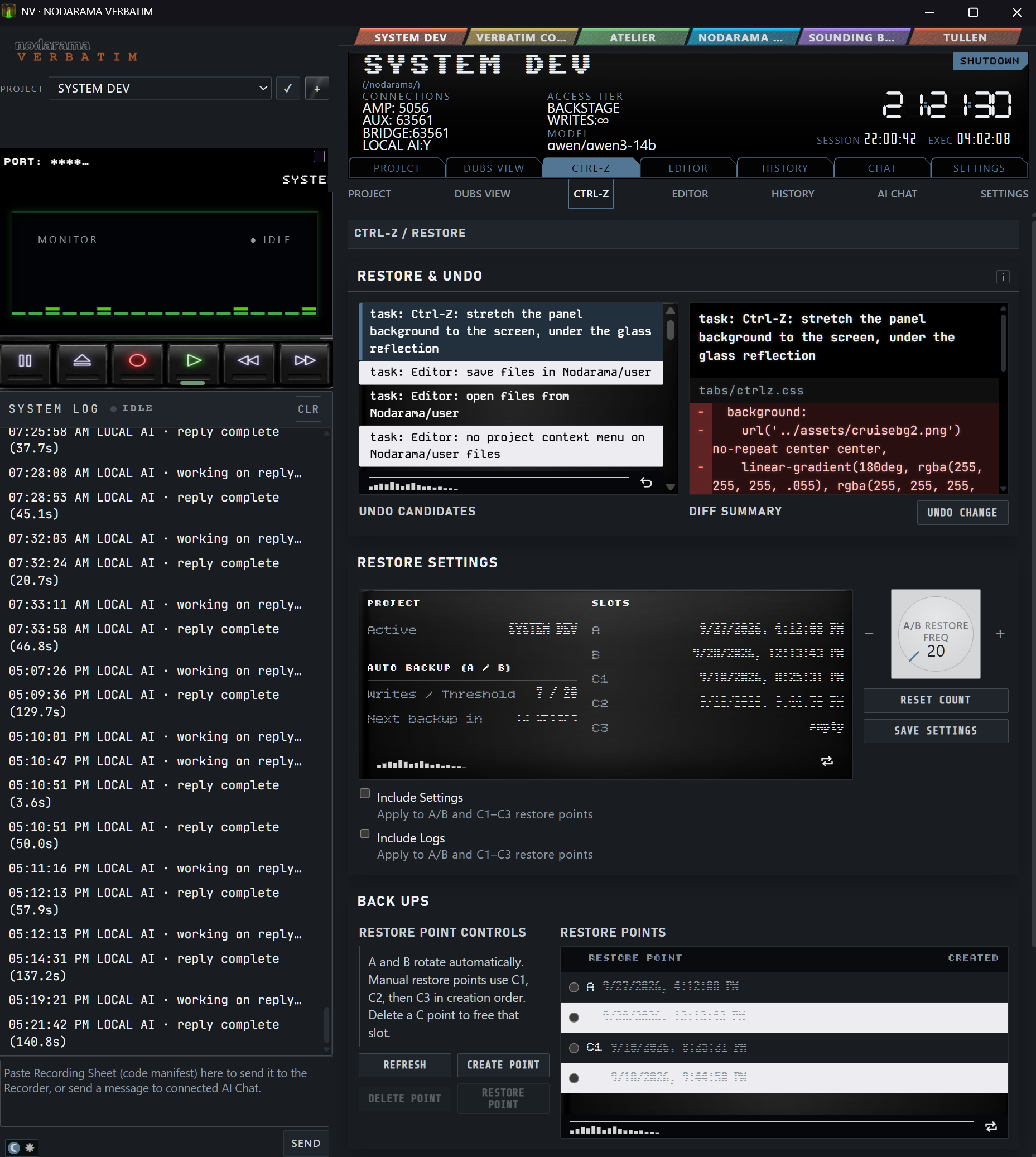 Screenshot of Enterprise skin for the Verbatim console.
Built on Sincerity, Ethics, and Personal Sacrifice
This development has been my full-time occupation for over a year. I have worked well over full-time hours, deeply obsessed with its delivery.
Where I may be less accomplished in traditional marketing, I am honest, open, and absolutely sincere in my effort to build something compelling that helps others see the genuine power and opportunity in AI—far beyond get-rich-quick schemes.
Nodarama is as ethical as I am. It isn't built to replace people's jobs or discontinue human contribution to society. It is built from the belief that everyone who wants to contribute more should be empowered to do so, now that these tools are accessible.
I am fully invested in Nodarama's mission. Forgoing a year's salary and funding the majority of this development from my personal funds—alongside meaningful support from my family—has enabled me to reach this point.
What Comes Next
I am pleased and proud to officially launch the release versions of Verbatim and the AUX Extension on the Chrome Web Store. With TulleN partially launched and Atelier not far behind, I am thrilled about what comes next.
We might not be finishing first, and we don't mind—because our vision and plan are grand, and we are going the furthest. I continue forward with immense enthusiasm, gratitude, and commitment to the journey ahead.
Roman Kiefer
Founder, Nodarama Determined Systems Limited.
