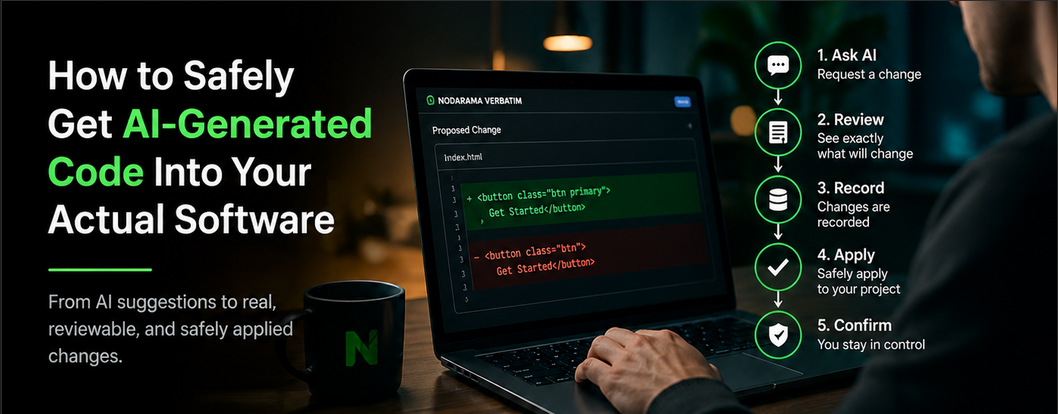
How to Safely Get AI-Generated Code Into Your Actual Software
AI can write code. The harder question is where that code actually goes.
Everyone talks about using AI to write code. Very few people explain what happens after ChatGPT, Claude, Gemini, or another AI gives you code.
It is easy to get your first AI-provided snippet. The next step is turning snippets into scripts, tools, apps, software, and systems on your own machine.
The first hidden problem
You ask AI to help build a feature. It gives you HTML, CSS, JavaScript, Python, React code, or backend updates.
Then you ask: Where does this actually go?
Or, a little further into it: How do I apply this without breaking everything?
The copy-paste trap
- Ask AI for code
- Copy the response
- Paste into random files
- Hope it works
This can create wrong file placement, overwritten code, broken dependencies, missing imports, deleted functions, broken styling, and no rollback history.
What safe transfer requires
Safe AI coding means knowing which file to edit, reviewing changes before they happen, maintaining history, preventing accidental damage, and understanding what changed.
This is where many AI coding workflows start to feel chaotic.
How Nodarama Verbatim helps
Nodarama Verbatim acts as a bridge between AI suggestions and real software execution.
Why this matters
Most AI tools help you create code. Very few help you safely deploy it into real projects.
That is where people lose time. That is where projects break. That is where beginners quit.
Final thought
If you are asking, “How do I get AI-generated code into real software?” you are asking the right question.
That problem is exactly what Nodarama Verbatim was built to solve.
Try Nodarama Verbatim