RANGES
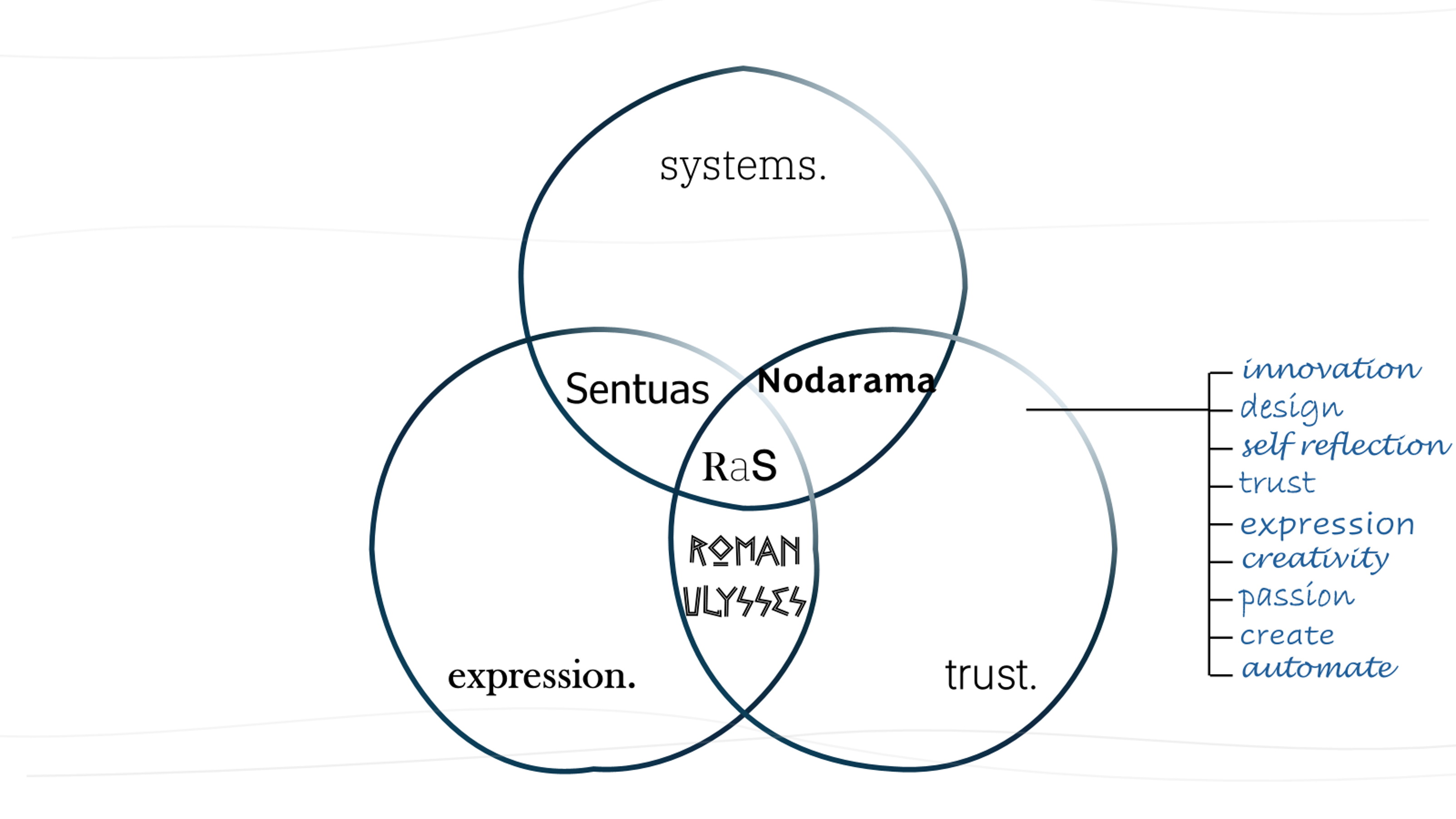
Roman Alpha Numeric Glyph Encoding System.
RANGES is a compact, shape-preserving naming system for code built around a simple idea: AI does not always need more language. Often, it needs clearer structure.
The hidden cost of descriptive code
Modern frontend code often accumulates names such as main-navigation-container-wrapper-inner. Each name may sound reasonable in isolation, yet repeated across HTML, CSS, scripts, prompts, diffs, and AI responses, descriptive naming can become a second layer of code that the system must continually interpret.
That extra language has a cost. It increases character count, consumes context, creates more opportunities for inconsistent naming, and makes targeted changes harder when several identifiers sound almost—but not quite—the same.
RANGES replaces that naming bloat with one brief semantic name and a compact relational glyph. The goal is not to remove readability. The goal is to preserve the shape of the system while removing unnecessary linguistic noise.
A coordinate system for code
RANGES stands for Roman Alpha Numeric Glyph Encoding System. Its glyphs can describe nesting depth, relationship, object type, and instance position.
<body class="Body-Ax">
  <main class="Site-Bx">
    <header class="Head-Cx">
      <div class="Title-Dx">
        <img class="Logo-Eo">
      </div>
    </header>
    <section class="Hero-Cx">
      <h1 class="Title Do"></h1>
      <img class="Art-Do">
    </section>
  </main>
</body>
The capital letter indicates depth. Elements sharing the same letter are structural peers. A lower-case suffix can indicate whether something is a container or an object: x for a container and o for an object. Numbers can distinguish repeated instances such as Button Eo1, Button Eo2, and Button Eo3.
The notation may use a space or a dash. Teams may encode position, branch, family, or sequence differently. The important rule is not rigid conformity; it is local consistency.
Shape preservation improves scannability
Code is not only language. It is also shape: hierarchy, containment, sequence, siblings, parents, children, and terminal objects. RANGES makes those relationships visible in the identifiers themselves.
For a person, this makes indentation levels and component boundaries easier to recognize at a glance. For an AI system, it provides compact structural coordinates that can help it follow where an element sits without repeatedly inferring the hierarchy from verbose names.
Less naming noise may reduce AI drift
AI models are linguistic systems. When a project contains many long, semantically similar identifiers, the model must distinguish between names that differ only by a few words or suffixes. That creates room for substitutions, invented variants, and broad rewrites when a narrow edit would have been enough.
RANGES reduces the number of competing words while preserving a stable location signal. That can make instructions more direct: change Title Do, insert after Hero Cx, or replace Button Eo2. The system becomes easier to target precisely, whether the change is made by a human, an AI, or a deterministic recorder.
This does not eliminate hallucinations by itself. It reduces one source of ambiguity: verbose, overlapping naming.
Efficiency compounds across the workflow
Shorter repeated identifiers reduce the amount of text carried through source files, prompts, responses, diffs, and logs. The exact savings depend on the tokenizer, language, project shape, and repetition pattern, but the effect compounds because the same names appear many times.
- More code can fit inside a fixed context window.
- Smaller prompts can reduce processing work and response time.
- Usage-based plans may cost less when fewer tokens are sent.
- Lower token volume can reduce compute demand and associated energy use.
- Smaller files are faster to transmit, index, compare, and search.
These are potential outcomes, not fixed guarantees. They should be measured against real projects. The useful principle is simple: every unnecessary repeated token is work performed again.
Precision surgery instead of broad rewrites
Compact, stable identifiers make manual search easier and support exact-locator workflows. A developer can find a structural node quickly, and an execution system can target the same text without guessing.
This changes the relationship with AI coding. Instead of asking a model to regenerate a large file to repair one detail, the user can request a narrow replacement against a recognizable coordinate. That makes changes easier to review, easier to diff, and easier to reverse.
A guideline, not another language
RANGES is intentionally lightweight. It can be explained in minutes, introduced gradually, and adapted to the structure of an existing project.
- Use one brief semantic name.
- Add a relational glyph.
- Let capital letters communicate depth or family.
- Use suffixes to distinguish containers, objects, steps, or forks.
- Add numbers only when instance identity matters.
- Choose one interpretation and apply it consistently within the file.
The purpose is not to force every team into one vocabulary. It is to give humans and AI a shared structural map.
Privacy through structural abstraction
RANGES also points toward a broader privacy model. Sensitive or proprietary identifiers can be replaced locally with compact structural coordinates while relationships, hierarchy, dependencies, and sequence remain intact.
An external AI could reason over the abstract shape while a local system retains the original mapping. The response could then be rehydrated into the private environment and executed under local control.
RANGES alone is not a complete privacy boundary. Comments, literals, routes, data, and business logic may still reveal meaning. Privacy requires deliberate local preprocessing, retained mappings, and controlled reconstruction. What RANGES contributes is a readable structural layer for that workflow.
Not minification. Not obfuscation.
Minification optimizes for machines by removing human readability. Obfuscation optimizes for concealment. RANGES is different: it attempts to preserve human scannability and machine usefulness at the same time.
Its strongest promise is not merely shorter code. It is a more precise interface between people, software, and AI—one where shape carries meaning, locations stay visible, and small changes can remain small.
The next interface for AI-assisted development
AI coding has largely inherited human naming conventions without asking whether those conventions are optimal for machine collaboration. RANGES asks a different question: what is the minimum readable representation that preserves everything needed to reason and act precisely?
The system is still evolving, and that is part of its value. It is open enough to test, measure, challenge, and improve. Its thesis is practical: stop making AI rediscover structure from prose, and start giving it structural coordinates directly.